Regalbuto
If you set out from Catania intending to reach the western part of Sicily, you will most likely choose to take the A19 Catania–Palermo motorway. The natural landscape you see from the car or the bus, in every season, is a constant invitation to get out and explore. The towns marked on the green signs are countless; few can actually be seen, and those that can are often particularly appealing — like Regalbuto, reached in about twenty minutes from the Catenanuova exit.
The town, today little more than six thousand inhabitants, was born in the Muslim era, its name probably derived from RAHL ABBUD, the hamlet of Abbud, its presumed owner. In 1090 the Grand Count Roger the Norman noted that the inhabitants were all Saracens; even today the “U Saracino” quarter, in the north-west, has preserved the Arab urban layout, rich in little streets, blind alleys, small courtyards and stairways. It was destroyed by the people of Centuripe in 1261 and then rebuilt by Manfred, son of Frederick II of Swabia, and later became a county. Many Arabs chose to remain in the town even after 1300, and for a great many years it was the Mediterranean emporium for wheat. A fortress was built at the top of the hill, and on its ruins was raised the Church of St Calogero, today a ruin with the appearance of a truncated tower; some documents in the archive of the Mother Church attest that it was King Manfred who built it.
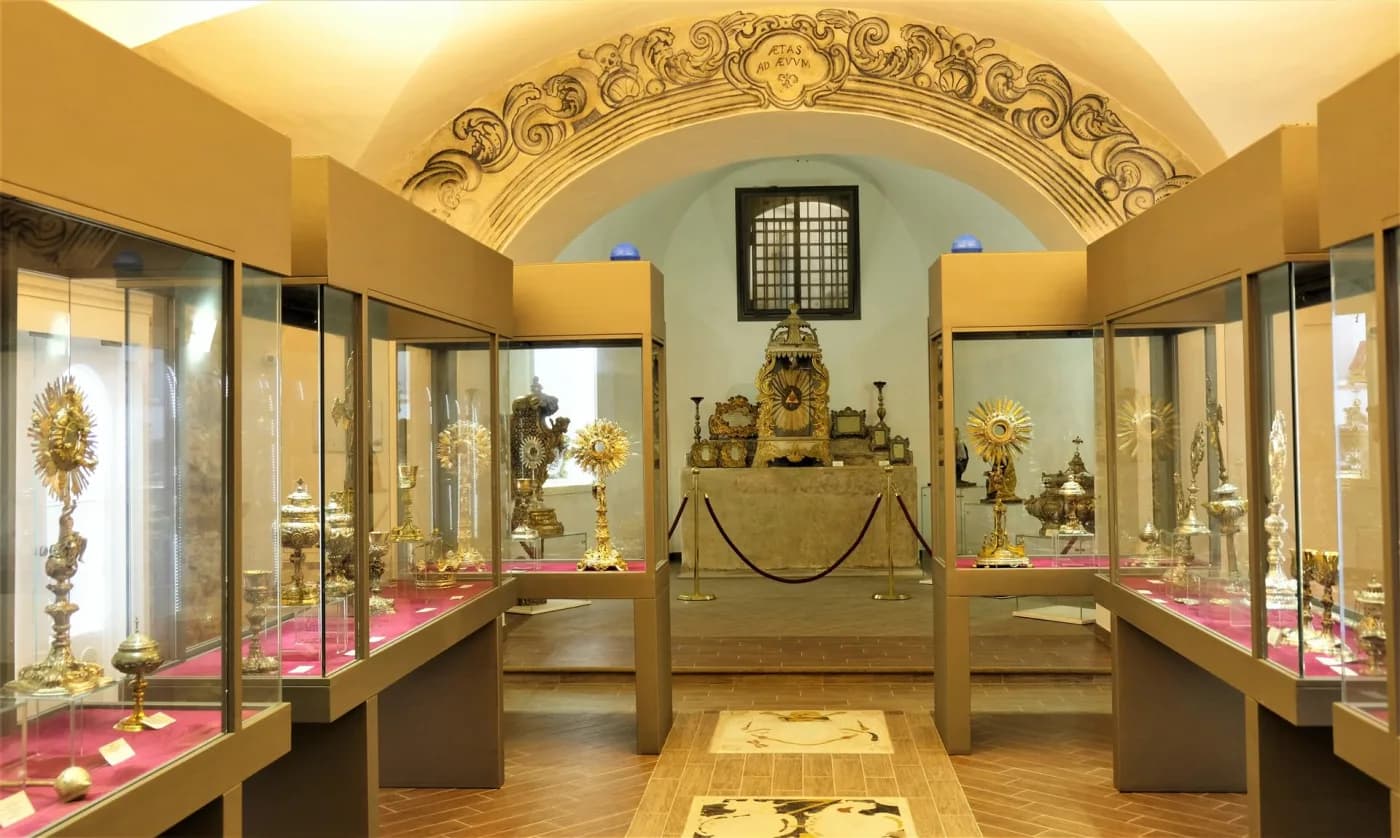
Sicilian Baroque has left interesting traces here, largely in the architecture overlooking Piazza della Repubblica — first among them the Mother Church, dedicated to St Basil the Great, a fact that suggests the present church stood where a small monastery of Greek-Byzantine Basilian monks once was. Completed around 1760 and set at the centre of the urban area, rich in churches and convents, it has severe outer forms with a vivid Baroque stucco decoration inside, a single nave with strongly projecting side chapels. In the vaults beside the church, once a grain store, a small and precious museum has recently been arranged, with reliquaries, crowns and other liturgical and devotional objects dedicated to the saint and to others connected with him — St Ignatius of Loyola, Modestus and Crescentius.
In the centre of Regalbuto, facing the church of Maria Santissima della Croce in Piazza Vittorio Veneto, is the Caffè of the same name run by Oscar Bonina, a young man born into the trade who, over the past few years, has renewed an excellent family tradition of pastry-making, creating new recipes and experimenting with particularly original combinations of products, all strictly from the local area. Surely one of the finest pastry shops in Sicily, and a member of the Kore Siciliae consortium.
Two kilometres from the centre, meanwhile, another young Kore Siciliae entrepreneur, Alice Bonina, runs the Adventure Park on Lake Pozzillo, the largest artificial reservoir in Sicily and a great natural attraction of the area, set in a boundless green plain that almost recalls Alpine landscapes, surrounded by a wooded area of eucalyptus and pine. The park is the ideal place to spend a pleasant day immersed in nature, in the spirit of adventure and fun. The facility has a refreshment point and a picnic area with barbecue.