Route 121
The lands of Kore Siciliae are the beauty of landscapes where the outline of the mountains, the flowing of the rivers and the breath of the wind fill the eyes and the soul. They are crossed by roads which — partly because they are not always up to standard in quality — force you into a slow journey, but give back all the more charm. One of these, the State Road 121, climbs the valley of the Fiume Torto and connects the Palermo area to that of Catania, touching Caltanissetta and Enna. It was the old sulphur road that replaced the railway, connecting the great mines, crossed by long files of two-wheeled carts, travelled by the miners and, before them, by the peasants who set out from the villages before dawn to go to work and returned late at night.
Today, leaving the Catania–Palermo motorway at Enna and heading to the right, you meet it after a few minutes at a fork which, to the west, skirting the city of Enna, leads towards Villarosa, one of the municipalities of the UNESCO Rocca di Cerere Geopark, a sulphur-mining centre very active in the nineteenth century with a railway terminal of the Sikelia mining line reserved for the sulphur mines of the district; its station houses the ethno-anthropological exhibition of mining art, of peasant civilisation, of emigration and of railway memorabilia, arranged inside eight old wagons used by the Nazis for the deportation of the Jews to the camps.
Heading north-east, instead, you follow a kind of Kore Siciliae itinerary made of small enterprises where you meet great women and great men, small towns where you visit great beauties, boundless landscapes that make you dream great dreams.
After a few kilometres, a jewel of a dairy took its name from the Raja district — set up by three young people, two sisters and a brother, who knew nothing about cheese but had a family tradition, and who have learned truly well, to judge by the quality and richness of their products.
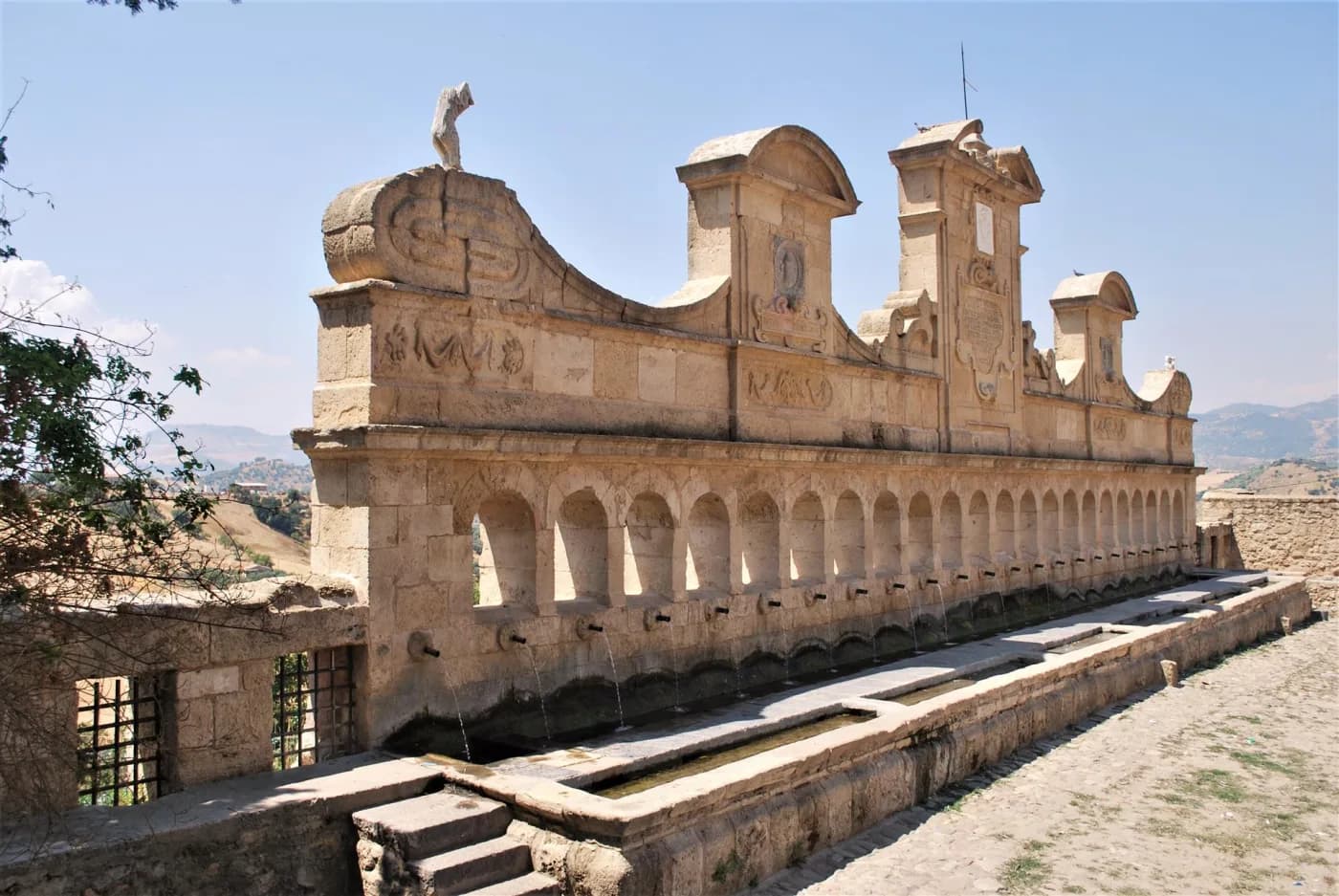
To find jewels made of metals and stones, instead, you must reach Leonforte, built in the seventeenth century by Prince Nicolò Placido Branciforti, whose family’s ancient residence is still preserved, where Giuliana Di Franco works in an atelier that resembles a domestic sitting room but also a jazz club and a cultural space. You can stop and get to know Giuliana’s mastery, but also stay overnight in one of the rooms set aside for visitors. Leonforte overlooks a valley rich in water, whose symbol is the monumental Granfonte fountain, built in a Baroque-Renaissance style on the remains of an ancient Arab fountain, its front facing the valley below with 22 arched windows beneath which 24 bronze spouts pour water into the great basin. And it was water itself that gave Francesco and Giuseppe Lo Gioco the idea of creating a workshop to produce handmade paper.
A very few kilometres and you reach Nissoria, a town founded in the eighteenth century but in which, not far from the centre, in the Torre district, you can visit what remains of ancient Nysura, a colony founded by populations of Greek-Byzantine origin. From Nysura one of the two Kore Siciliae enterprises operating here takes its name, producing gin and herb distillates; the other, Agrirape, cultivates the Leonforte PGI peach and turns it into jam, also involving visitors who might wish to take part in a curious experience.
And if — running the calculated risk of appearing fashionable — you wish to close the Kore Siciliae Route 121 itinerary with a triumph of identity food, a stone’s throw from Nissoria there is a place that has made identity cuisine its calling card: the Ristorante San Giorgio, in the hamlet of the same name belonging to Assoro. To enjoy, instead, one of the most extraordinary pastry shops in Sicily, the Caffè Vittorio Veneto, you must travel some twenty kilometres and reach Regalbuto, with a historic centre of Arab urban design where the eighteenth-century Mother Church dedicated to St Basil is worth a visit, together with the small but interesting museum annexed to it, which displays liturgical and devotional objects.