Villa del Casale: Otium et negotium
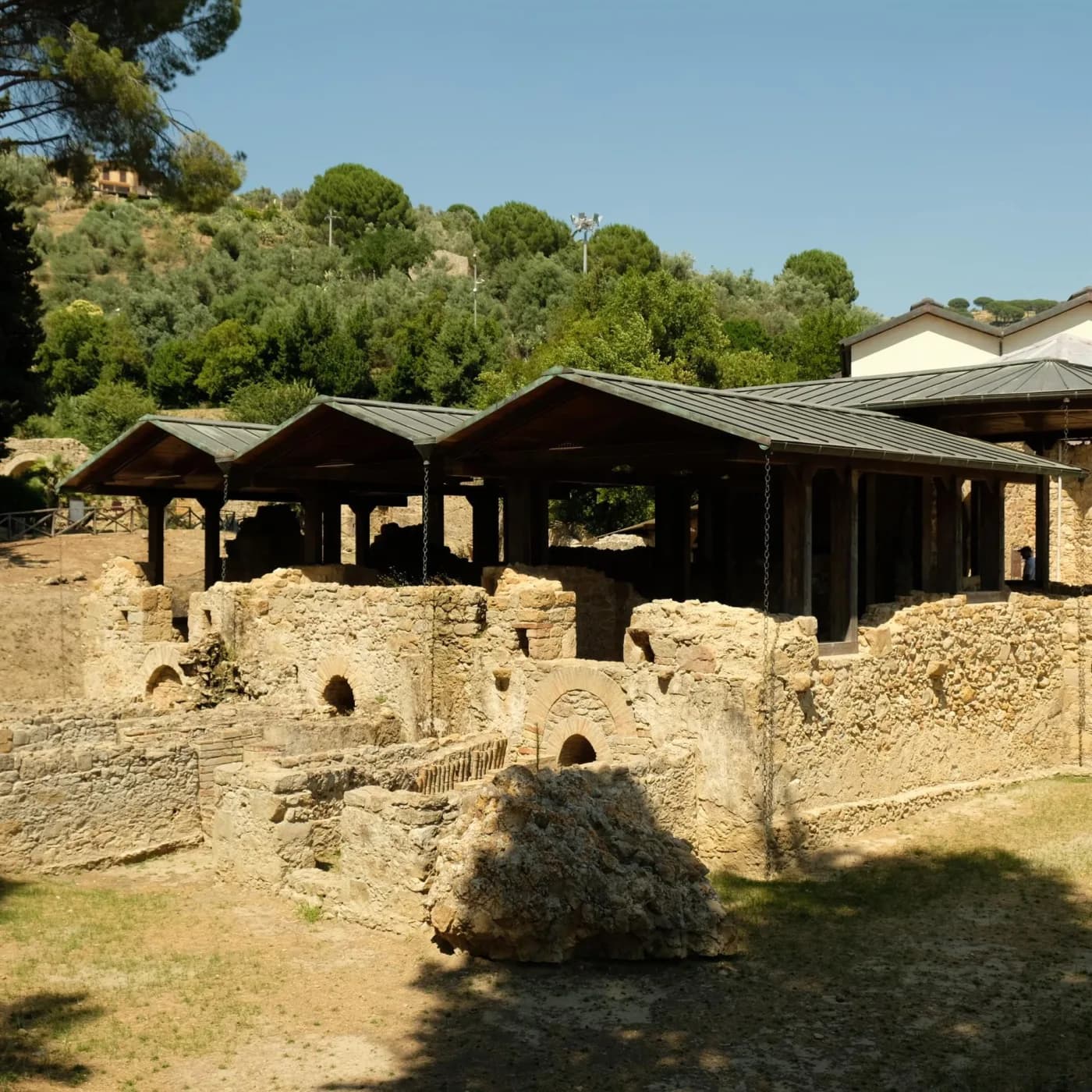
Beyond the river and among the trees, it seems set into a landscape that at once conceals and reveals it to those who come along the Gela stream — a place of memory and of desire. But have you ever wondered how many real people, how many mythological figures, how many erotes populate the mosaics of the Villa del Casale? And how many different animals, real or imaginary, have been depicted: among birds, fish, amphibians and mammals? By a rough count, there are more than 450 recognisable animals, more than seventy mythological figures, more than 80 erotes, more than 300 people, each engaged in a different situation. We may suppose that at least 300 people habitually lived in the villa. And they all have something to tell us, for they are portrayed in various occupations: they hunt, they sacrifice, they play, they eat, they talk among themselves. The so-called rooms of the dominus are perhaps the most private in the house, and there tales of love and eros are told. And yet our curiosity does not stop, and we discover a scene of a private performance — or perhaps not, perhaps one held in the xistus, but which remained memorable — in the open air against the backdrop of the hills that overlook the river flowing at the foot of the villa, crowned by the silhouettes of maritime pines exactly as they still are today. And so we can walk through the halls of the villa following different itineraries, in search of people’s faces, their clothes, their gestures and their habits — such as those of perfuming, of massages, of dances, of gymnastic exercises. Or search for the more than sixty musical instruments depicted in the banquet scenes, or try to recognise all the kinds of fish that were daily food. And the flowers portrayed in nature or forming auspicious garlands, and the grape harvest carried out in play by children who then go to the winepress to tread the grapes. And the races in the Circus Maximus in Rome and in a small circus where children race in chariots drawn by birds that may be ostriches. And the architecture, the ships, the transport wagons, with their technologies and their workers, the capture of the beasts for the gladiatorial games in the arena. It is an endless catalogue and the representation of a living humanity, daily engaged in public affairs and devoted to private otia, in Rome as in the villa, in Alexandria as in Ostia, or on the Black Sea to embark exotic animals and precious materials such as that pink marble of India, of which two panels are found in the Basilica and two in the side altars of the cathedral of Piazza Armerina.
Writing is absent from the villa: we know of no inscription apart from a stamp on a lead pipe, the numbers on the sacks of prizes for the poetic contest, but we have no known literary or epistolary descriptions of it as we do for the domus of rhetoricians, poets and princes. Nothing known to us: a silence maintained over the centuries for a complex that remained alive at least until the threshold of the Norman age, with significant and archaeologically attested Byzantine and Muslim presences.
The Casale is neither the first nor the only villa in Sicily: a short distance away, at Gerace, further to the north-west, a great dwelling with mosaic interiors serves as its counterpart, and we may imagine mutual visits between the great landowners and their families. Certainly the size of the basilica — identical to that of Diocletian at Split — cannot but astonish in a private dwelling. But other residences in Sicily also present great halls, Thermae and mosaics. In the grain-growing areas, on the coast, more or less everywhere, great dwellings have been found — as at Patti, at Messina, at Noto, at Siculiana, in the Trapani area. It tells of a wealthy society in which the “humble” are present; it describes a society in which domestic roles are defined and not mutually oppressive, so much so as to suggest a female presence — of rich and cultured dominae — that goes beyond mere presence, to the point of suggesting that it was the domina who was the true mistress of the house. We shall have to come back and speak with these figures, who seem to be waiting for nothing but to be addressed so as to rise and tell us their stories.